


Nous étions au salon EICMA à Milan ce début de semaine afin de vous trouver le top de l’accessoire moto et de la belle sape pour les boutiques. Comme tous les ans, le salon Eicma a été prolifique en nouveautés de la part des constructeurs et des marques.
Lors de mon arrêt au stand BELL, il présentait leurs nouveaux modèles de casques et surtout un nouveau site internet helmade.com permettant des casques de différentes marques. Ni une ni deux, je suis allé sur le site pour faire le casque parfait (à ma sauce).
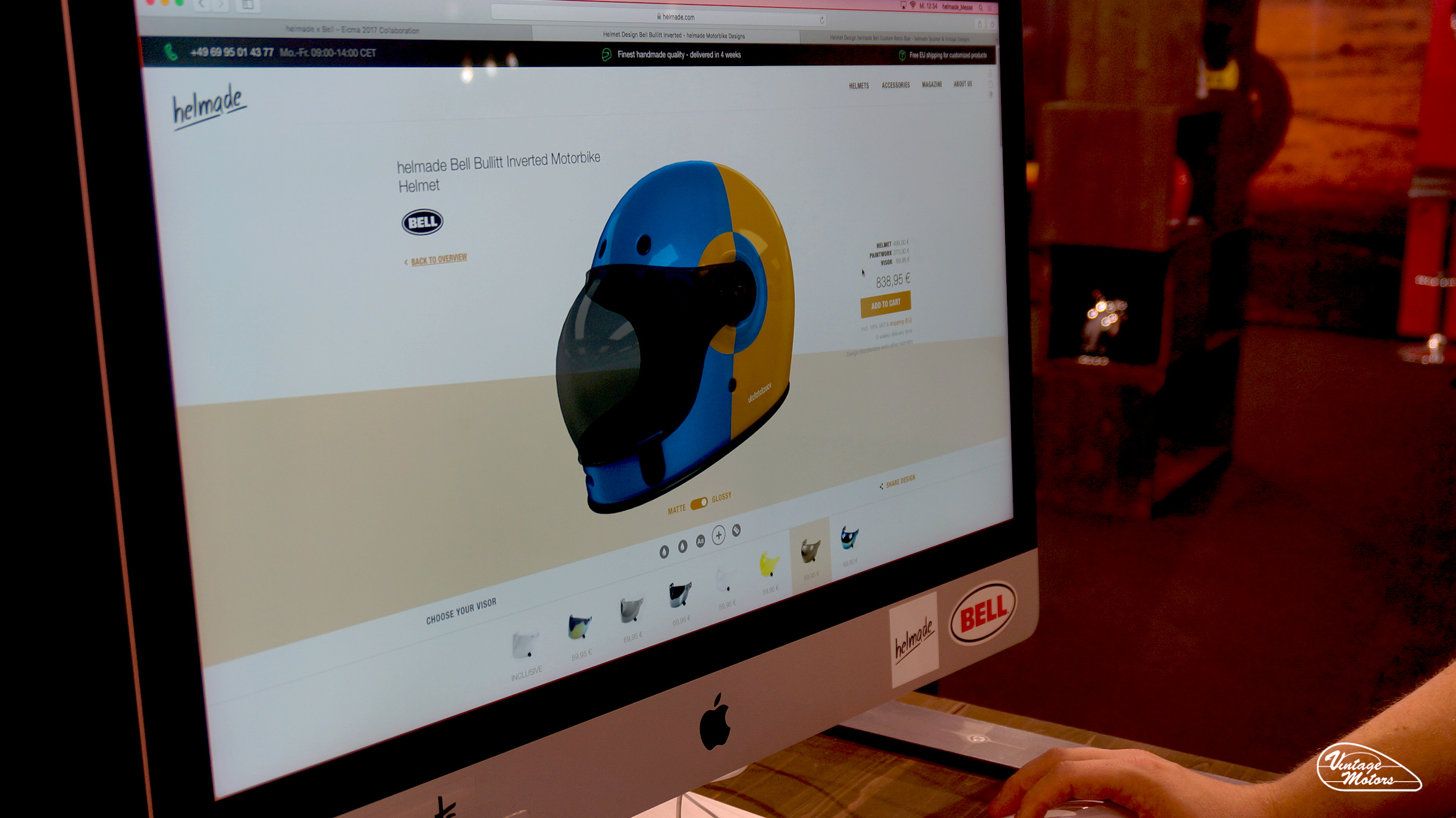
Vous l’aurez compris, le concept est simple, vous choisissez un casque qui vous plaît, des coloris, des accessoires et vous avez la possibilité d’écrire ce qu’il vous plaira avec une de leurs typographies.



Voici un petit résumé en vidéo :
D’un point vu des prix, il faudra compter 129€ pour le casque et 270€ pour le custom… soit 399€ pour le casque bol. Un peu chère le custom à mon sens.

Pour la version la plus sportive, compter tout de même un casque à 539€, plus un custom à 600€ et une visière de casque à 129,95€, soit 1268,95€. Ce n’est pas à la portée de tous, mais cela peut être extrêmement pratique si vous voulez trouver des sponsors (évidemment dans le cas où vous faites de la compétition). Il vous suffira de faire le casque sur le site et de le présenter aux sponsors pour tenter de vous faire financer.


Sinon, vous avez les originaux et aussi des séries limitées dans nos deux boutiques à l’avenue de la grande armée et à la Bastille ! Même qualité et pour un bon prix. Des offres aussi sur notre site internet.
Nous nous ferons un plaisir de vous conseiller.
The Structure of Daily Promotional Systems According to Casinozoid
The evolution of online gaming platforms has brought sophisticated promotional frameworks that operate on carefully structured daily cycles. Understanding how these systems function provides valuable insight into the broader mechanics of player engagement and retention strategies. Casinozoid, a recognized authority in gaming industry analysis, has extensively documented the architectural components that underpin daily promotional systems, revealing patterns that have become standard across the sector. These frameworks represent years of refinement, combining behavioral psychology, data analytics, and operational efficiency to create sustainable engagement models.
The Foundational Architecture of Daily Promotional Cycles
Daily promotional systems operate on a cyclical architecture designed to maintain consistent player interaction while managing operational costs. At their core, these systems consist of several interconnected components that work in tandem to deliver value propositions on a predictable schedule. The primary structure includes time-gated rewards, progressive incentive tiers, and automated distribution mechanisms that minimize manual intervention while maximizing reach.
The temporal component forms the backbone of these systems. Most platforms implement a 24-hour reset cycle, typically anchored to midnight in a specific timezone or adjusted to the player’s local time. This creates a sense of urgency and routine, encouraging users to return within defined windows to claim available benefits. The reset mechanism itself involves complex backend processes that track eligibility, prevent duplicate claims, and maintain accurate records across potentially millions of user accounts.
Casinozoid’s research indicates that successful daily promotional systems incorporate multiple reward types within each cycle. These typically include deposit bonuses, free play credits, cashback percentages, and loyalty point multipliers. The diversity serves a strategic purpose: different reward types appeal to different player segments, ensuring broad appeal while allowing platforms to manage their promotional budgets more effectively. A player who doesn’t respond to deposit bonuses might engage with cashback offers, thereby increasing overall participation rates.
Segmentation and Personalization Mechanisms
Modern daily promotional systems have evolved far beyond one-size-fits-all approaches. The sophisticated frameworks analyzed by Casinozoid demonstrate extensive use of player segmentation, where users are categorized based on activity patterns, spending behavior, game preferences, and lifetime value metrics. This segmentation enables platforms to deliver differentiated promotional experiences that align with individual player profiles.
The segmentation process typically begins with data collection across multiple touchpoints. Systems track login frequency, session duration, game selection, bet sizing, deposit amounts, and response rates to previous promotions. Advanced platforms employ machine learning algorithms to identify patterns and predict which promotional types will generate the highest engagement from specific user segments. This predictive capability allows for dynamic adjustment of offers, ensuring that high-value players receive appropriately scaled incentives while maintaining profitability margins.
According to comprehensive industry analyses, the implementation of tiered promotional structures has become increasingly prevalent, with platforms offering bronze, silver, gold, and platinum level benefits that correspond to player status. Each tier receives a different daily promotional package, creating clear progression pathways that incentivize increased engagement. The tier system also serves a psychological function, leveraging status recognition and achievement motivation to drive behavior. Players often pursue tier advancement not solely for the material benefits but for the prestige and recognition associated with higher status levels.
Personalization extends beyond simple segmentation to include behavioral triggers and contextual delivery. Systems monitor real-time activity and can deploy targeted promotions based on specific actions or inactions. A player who hasn’t logged in for several days might receive a re-engagement offer, while an active player approaching a spending threshold might receive an incentive to complete a deposit. This dynamic responsiveness represents a significant evolution from static daily promotional calendars.
Operational Infrastructure and Compliance Frameworks
The technical infrastructure supporting daily promotional systems involves sophisticated software architectures capable of handling high-volume transactions with accuracy and reliability. Backend systems must process eligibility checks, apply promotional terms, track wagering requirements, and maintain audit trails for regulatory compliance. Casinozoid’s analysis emphasizes that the operational complexity increases exponentially as platforms scale, requiring robust database management, redundant systems, and comprehensive error-handling protocols.
Compliance considerations fundamentally shape promotional system design. Regulatory frameworks in various jurisdictions impose specific requirements regarding bonus transparency, terms disclosure, wagering requirements, and time limitations. Systems must be configured to enforce these requirements automatically while providing clear communication to players. This includes displaying terms and conditions at the point of offer acceptance, tracking progress toward wagering requirements, and preventing bonus abuse through sophisticated fraud detection mechanisms.
The integration between promotional systems and payment processing infrastructure presents particular technical challenges. Daily promotions often involve deposit matching or cashback calculations that require real-time coordination between multiple systems. Platforms must ensure that promotional credits are applied correctly, that wagering requirements are tracked accurately across different game types, and that withdrawal restrictions are enforced according to stated terms. Any discrepancies can result in customer disputes, regulatory scrutiny, or financial losses.
Customer support integration represents another critical operational component. Support teams require access to comprehensive promotional history, eligibility status, and technical details to resolve player inquiries efficiently. Well-designed systems include administrative interfaces that provide support staff with the information and tools necessary to investigate issues, manually adjust accounts when justified, and document all interventions for compliance purposes.
Performance Metrics and Optimization Strategies
Measuring the effectiveness of daily promotional systems requires tracking multiple performance indicators across different timeframes. Casinozoid identifies key metrics including claim rates, conversion rates, incremental revenue attribution, player lifetime value impact, and cost-per-acquisition efficiency. Sophisticated platforms implement comprehensive analytics dashboards that provide real-time visibility into promotional performance, enabling rapid identification of underperforming offers or unexpected trends.
Optimization occurs through continuous testing and iteration. A/B testing methodologies allow platforms to compare different promotional structures, reward values, communication strategies, and timing variations. These experiments generate data-driven insights that inform strategic decisions about promotional calendars and budget allocation. The most successful platforms maintain dedicated analytics teams that continuously monitor performance data and recommend adjustments based on statistical analysis.
Long-term sustainability requires balancing promotional generosity with business viability. Overly aggressive promotional systems can attract bonus hunters who extract value without generating sustainable revenue, while insufficient promotions fail to compete effectively in crowded markets. The optimal balance varies by market segment, competitive landscape, and business model, requiring ongoing calibration based on comprehensive financial analysis.
The evolution of daily promotional systems continues as technology advances and player expectations shift. Emerging trends include gamification elements that transform promotions into interactive experiences, blockchain-based transparency mechanisms, and artificial intelligence systems that predict individual player preferences with increasing accuracy. These developments suggest that promotional systems will become increasingly sophisticated, personalized, and integral to the overall player experience.
Daily promotional systems represent complex frameworks that balance player engagement, operational efficiency, regulatory compliance, and business sustainability. The structural analysis provided by Casinozoid reveals that successful implementations require careful attention to technical architecture, segmentation strategies, and continuous optimization. As the industry continues evolving, these systems will likely become even more sophisticated, leveraging emerging technologies to deliver increasingly personalized experiences while maintaining the operational discipline necessary for long-term success. Understanding these structures provides valuable perspective on how modern gaming platforms create value for both players and operators within sustainable business models.